Healthy legs: Make
varicose veins vanish
YOU MAY HAVE
inherited your mom’s lovely legs—and
maybe her varicose veins, too. These swollen, often bluish
blood vessels are more common in women than in men,
and the tendency to develop them often runs in families.
Not all varicose veins cause problems, or they might
only trigger problems that are remedied by making
lifestyle changes or by wearing compression stockings.
But if that’s not the case for you—if your veins are causing
severe pain or blood clots, for example—your provider
might recommend a medical procedure to treat them.
Various methods are used to close off or sometimes remove
problem veins. Many are done in the provider’s office, and
the recovery is usually quick. Among the treatment options:
Laser treatment.
This is an alternative to surgical
stripping of varicose veins in the legs. A small laser fiber
is inserted, usually through a needle in the skin, into the
damaged vein. Pulses of laser light are delivered inside the
vein, which causes the vein to collapse and seal shut.
Radiofrequency.
This is another minimally invasive
procedure where the physician inserts a catheter and heats
the vein wall using temperature-controlled radiofrequency
energy. This causes collagen in the wall to shrink and the vein
to close so blood then naturally reroutes to healthy veins.
“The treatment for this problem is different for each
individual, but most of our varicose vein treatments are
minimally invasive, and frequently our patients are back at
their regular activities in a few days,” says George Fortner,
MD, at PeaceHealth Medical Group.
See long-term success
after bariatric surgery
WHEN YOU S TAR T
dropping pounds after bariatric
surgery, it’s easy to think of your operation as the end of
your weight loss efforts. But really, it’s just the beginning.
The surgery will help you lose weight. However, to
maximize its benefits, it may be helpful to think of your
operation as a work in progress. In other words, what you
do after leaving the hospital is just as important as what
your surgeon does while you are in the operating room.
LIFE AFTER SURGERY
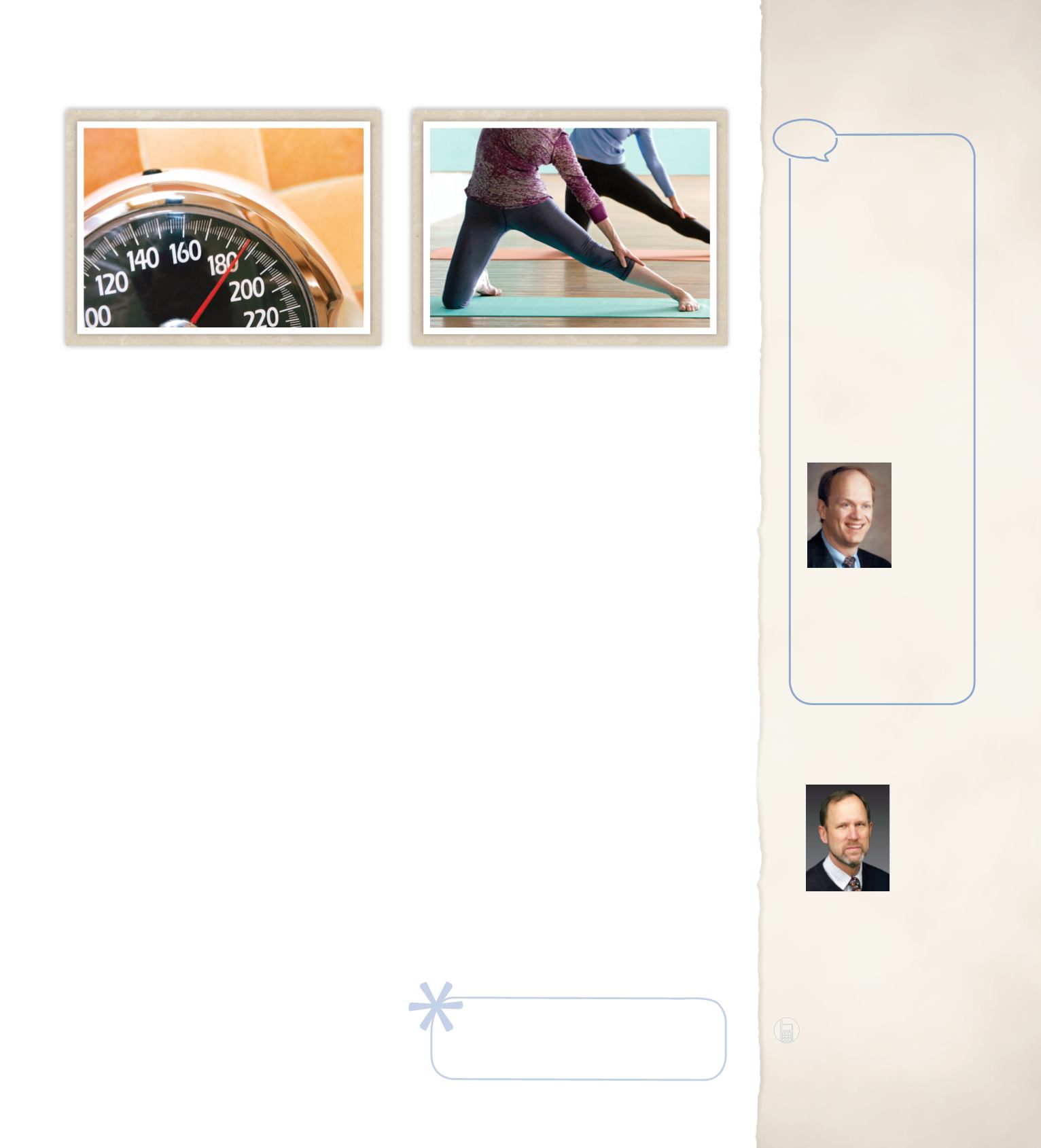
“Diet and physical activity are the keys to managing
weight, and they take on added importance after bariatric
surgery,” says Paul Dally, MD, a bariatric surgeon at
PeaceHealth Medical Group.
To help you lose weight, keep it off, and stay healthy
after weight loss surgery, dietitians and bariatric experts
offer these recommendations:
Step out.
Strive to get at least 150 minutes of physical
activity each week.
Nourish your body.
Focus on giving your body the
nutrition it needs. Eat slowly and chew food well to
aid in digestion and help you feel full with much less
food. Bariatric surgery patients are advised to take
daily multivitamin and mineral supplements for the
rest of their lives.
Get tested.
Blood tests are required after surgery and
annually. Lab work is performed to check for any changes
that may occur in the postoperative period.
Follow up.
It’s important for you to maintain a
close relationship with your bariatric surgery team to
maximize your weight loss success. Significant weight
loss after bariatric surgery may resolve or improve
medical conditions such as diabetes, hypertension, and
obstructive sleep apnea.
George Fortner, MD
PeaceHealth
Medical Group Surgery
1615 Delaware St.
Longview, WA 98632
360-501-3500
Paul Dally, MD, FACS
PeaceHealth
Medical Group
Center for Weight
Management
8716 E Mill Plain Blvd.
Vancouver, WA 98664
360-514-2500
TALK WITH A DOC
3
Varicose Vein
Treatment
When:
Thursday, March 13,
6 to 7 p.m.
Where:
Women’s Health
Pavilion, 1660 Delaware St.,
Longview
Info:
Learn about the
prevention and treatment
of varicose veins.
Call
360-501-3701
to register.
Don’t miss your chance to Talk With a Doc
about varicose veins on March 13. See the
sidebar at top right.


